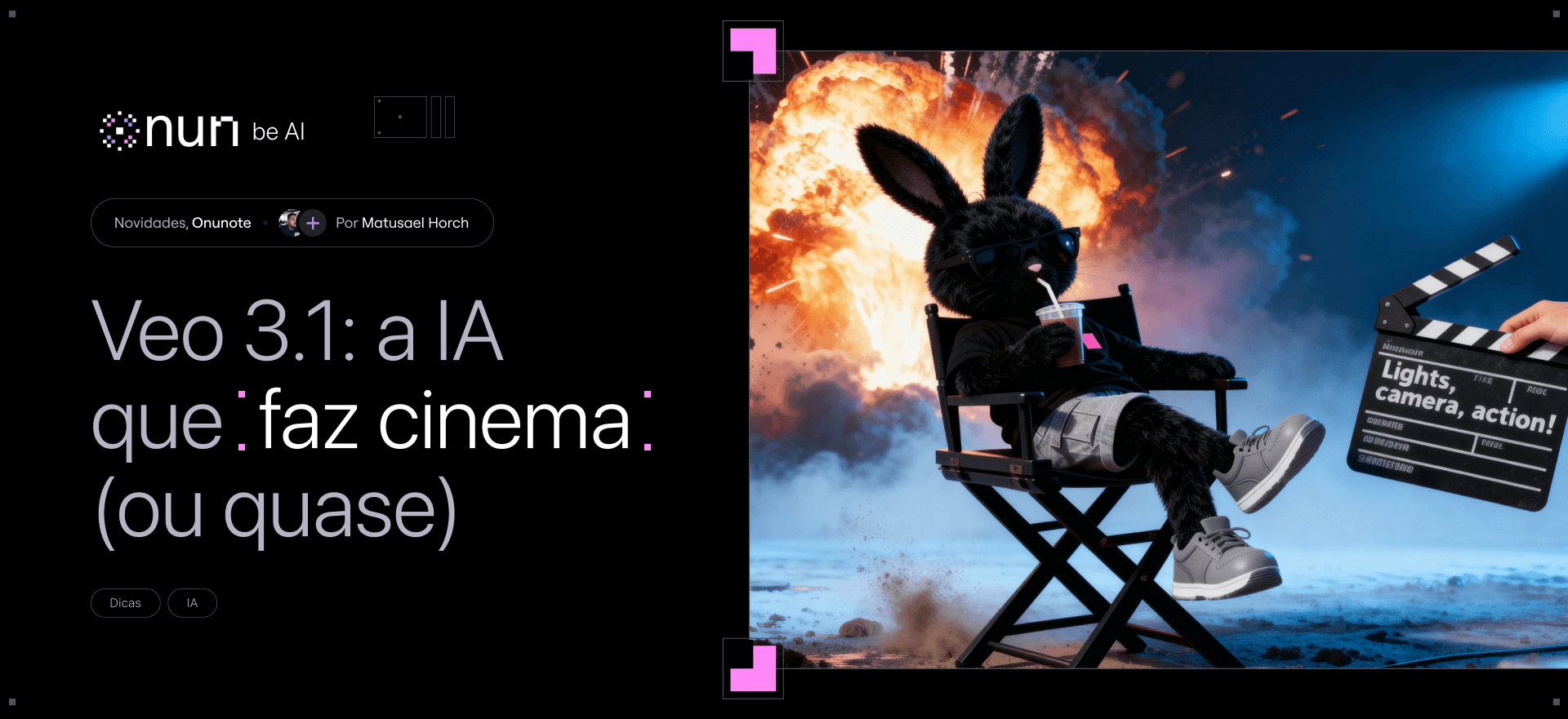
Google released an AI that makes videos. And honestly... it is getting interesting.
275 million videos in 5 months.
That is the number Flow — Google's generative video tool — reached since launch.
No, they are not all masterpieces.
Yes, many are strange.
Yes, there are obvious limitations.
But here is the plot twist: a good share of those videos is already commercially usable.
Now Veo 3.1 has arrived: the upgraded version.
Let's see what is happening.
What can this AI do (when it cooperates)?
Let's be realistic about its capabilities:
🎥 Generates audio that matches the scene
It works most of the time. Sometimes it surprises you; sometimes it needs manual adjustments.
🎥 Creates transitions between two frames
You provide the start and end, and it fills in the middle. When it works, it feels like magic. When it misses, you generate again.
🎥 Combines visual references to create a scene
A success rate of around 70%. Add a character, setting and mood, and it interprets them to deliver something close to what you imagined.
🎥 Extends videos while keeping the vibe
It can create longer takes with continuity. Simple scenes work better; complex ones can break down.
🎥 Adds or removes elements
It also rebuilds backgrounds, shadows and lighting. Quality varies, but it works.
The overall picture:
Like a talented but unpredictable assistant. It does not always deliver perfection, but when it delivers, it is quick and affordable.
The numbers that change the game
Let's compare:
| Criterion | Traditional production | Veo 3.1 |
|---|---|---|
| Quality | 100% | 60–70% of the ideal |
| Control | Full | Directional |
| Predictability | High | Medium (iteration required) |
| Time | 3–4 weeks | 1–2 days |
| Investment | BRL 30,000 | BRL 500–2,000 |
The question is not “which is better?”
It is: “How many clients need 100% when 80% costs 6% of the price and arrives in 10% of the time?”
More than you might think.
Where it shines and where it still struggles
✅ Works well for:
- Conceptual and atmospheric content
- Brand hero videos
- High-volume social media
- A/B testing at scale
- Rapid idea prototypes
⚠️ Still struggles with:
- Keeping the same character across multiple takes
- Realistic physics (water, fire, fabric behaving like fabric)
- Precise camera control
- Any text in the scene (expect an alien alphabet)
- Scenes with lots of interaction between elements
In practice:
It is no magic wand, but it already serves a large part of the content market.
Who feels the impact?
The straightforward content production market:
Corporate videos, product hero videos, scalable social media and creative testing.
What does that mean in practice?
The differentiator has shifted from “executing well” to “thinking well.”
Anyone with BRL 500 in API credit can now execute reasonably well.
What remains is:
- A strong creative vision
- Reference curation
- Direction of generative workflows
- Stories AI cannot create on its own
Available now
Available through:
- Gemini API
- Vertex AI
- Gemini App
Any studio, agency or freelancer can try it.
Is there a learning curve? Yes.
Will you need ten versions to get three good ones? Probably.
Will you need post-production? Most of the time.
But the math has changed:
- 10 times cheaper
- 5 times faster
- “Good enough” for most briefs
That is already enough to move the market.